Thursday, 25 October 2012


Yes Scotland Update


Blair Jenkins, the chief executive of Yes Scotland, recently laid out the key arguments for an independent Scotland.

In a major speech, he said the 2014 referendum presented Scots with a unique opportunity to build a better Scotland. One that was inclusive, fairer and more equal. And that was why he was convinced 2014 would be the “Year of Yes”.

But Yes Scotland needs your help to make that happen and we are pleased to unveil two new ways for you to help our campaign.

First of all, it is now possible to set up regular, monthly donations to Yes Scotland (This will take you to a completely secure URL.) We are a grassroots campaign and regular donations, of any size, from our supporters will help us plan our campaign and create the resources necessary to win the argument.

Set up a regular donation here

We are also pleased to announce to launch of our online store, where you can buy Yes merchandise such as:

  • T-shirts
  • mugs
  • badges
  • bags
  • pens
Buying items from the store will help fund our campaign and spread our positive message.

Visit our store here

The highlights of Blair’s speech at the prestigious Donaldson Lecture at the SNP conference were:
  • 'We know that under successive Labour and Conservative governments, the UK has become one of the most unfair and unequal societies in the Western world. That didn’t happen as an act of God. It was an act of policy.”
  •  “The vision of an independent Scotland that many of us have is of a country where all of us look out for one another, and where our sense of duty and responsibility to other people doesn’t begin and end at our own front door.” 
  • “Most of us value the notion of a society that is inclusive, where communities and individuals are not left behind and are not marginalised; a country where access to Higher education does not depend upon the wealth of your parents; a country where your health and your lifespan does not depend upon where you were born or where you live; a country where we value investment in people and investment in society. And where old age is not a time of loneliness and fear.'
  • “As far as Yes Scotland is concerned, all we ask is that you support the core principle - the core democratic principle - that the best people to make decisions about the future of Scotland and what is right for Scotland are the people of Scotland themselves, the people who live here, the people who work here.”
You can watch the full video at YesScotland.net.

He also asked the question: “If Scotland was an independent country today, who would vote to join the Union?” You can watch a short video of that here.

Thank you very much for your help. It is only with your support that we will win in 2014.

Yes Scotland
http://www.yesscotland.net/

Monday, 15 October 2012


Scottish reshuffle: Salmond appoints Sturgeon referendum supremo

Deputy first minister to oversee economic policy and direct preparations for 2014 referendum on independence
Local council elections
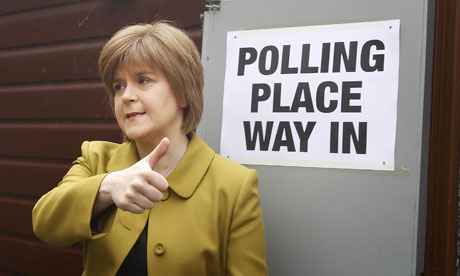
'I look forward to winning': deputy first minister Nicola Sturgeon takes on responsibility for government strategy and the constitution. Photograph: Danny Lawson/PA
Alex Salmond has again attempted to bolster the independence campaign by asking his highly-regarded deputy first minister Nicola Sturgeon to direct the Scottish government's referendum strategy.
Charged too with overseeing economic policy, Sturgeon will spearhead the Scottish government's preparations for the 2014 referendum, starting on Thursday with a meeting with the UK government Scotland minister David Mundell.
Sturgeon's appointment came after the first minister held a snap reshuffle.
Forced on Salmond partly by the decision of his senior constitutional affairs minister Bruce Crawford to retire, Sturgeon's new posting is the most significant in a series of recent personnel changes within his government and the Scottish National party as the political pace around the referendum sharply accelerated.
Sturgeon, the longest serving Scottish health secretary since devolution and widely tipped as the SNP's most likely successor to Salmond, has successfully piloted through two of the SNP government's most contentious measures, with legislation on alcohol minimum pricing and cabinet approval for a gay marriage bill.
A firm proponent of a single "yes or no" referendum question on independence, she has been critical of Salmond's behind-the-scenes efforts to find a coalition of civil and business leaders to fight for a second question on increased devolution. That option is now thought to be dead: Salmond is understood to be committed to a single question vote in 2014.
Salmond's most influential and experienced special adviser, Kevin Pringle, moved last month from his government post to become the SNP's head of strategic communications; on Sunday, the official Yes Scotland independence campaign unveiled its executive team.
Salmond said on Wednesday that a date had been pencilled in within the next few weeks for his meeting with David Cameron to agree the terms of the 2014 referendum and the legislation needed to enact it; Downing Street said dates were under discussion, but none had yet been confirmed. The first minister said he believed a deal would be struck when he meets the prime minister.
Crawford had been leading the talks with Mundell on the precise detail of the referendum, which is now widely tipped to see votes for 16- and 17-year-olds; supervision by the Electoral Commission; legal approval by the Westminster government; and a single "yes or no" question on independence.
Salmond said both he and Cameron were keen for that deal to be struck. "My understanding [is] he's anxious to have the meeting and I'm anxious to have it," he said. "I think progress has been made. I have never regarded these things as presenting insuperable obstacles and nor have they."
The reshuffle means that seeing the same sex marriage bill into law despite vigorous opposition from the Catholic church and defending the minimum pricing act against court action by Scotch Whisky Association now fall to new health secretary Alex Neil, the former infrastructure minister who was previously one of Salmond's fiercest internal critics and a former party leadership contender.
Aware of the risk that Sturgeon's move would provoke allegations that the NHS was being downgraded by his government, Salmond said Neil was one of his most formidable ministers. "Alex Neil is a very, very serious political figure and a figure of great substance," the first minister said.
No other senior cabinet posts have changed, but three other junior ministers have been sacked and replaced by backbench MSPs.
Brian Adam is replaced as minister for parliamentary business by Joe Fitzpatrick, MSP for Dundee City West. Stewart Stevenson is replaced as minister for environment and climate change by Paul Wheelhouse, MSP for South Scotland, and one of the party's brightest media performers, Humza Yousaf, the MSP for Glasgow, becomes the new minister for external affairs and international development. Margaret Burgess, MSP for Cunninghame South, is a new minister for housing and welfare.
Having formally taken on the role of cabinet secretary for infrastructure, investment and cities, with "lead responsibility for government strategy and the constitution", Sturgeon told Holyrood on Wednesday that she was "extremely excited" by her new post.
"I look forward to making that positive, that honest, that upbeat case over the next two years and I look forward to winning the independence referendum in 2014," she said.

Scotland countdown to secession poll

SCOTLAND has formally begun a two-year to a referendum on breaking up the UK, with independence campaigners banking on a surge of Scottish nationalism during the 2014 Commonwealth Games in Glasgow.
British Prime Minister David Cameron last night signed off on the holding of a referendum in the weeks after the Glasgow Games, where local athletes will compete under a Scottish flag, unlike at the London Olympics where they were part of "Great Britain" or "Team GB".
The agreement between the Mr Cameron and Alec Salmond, the pro-independence First Minister of Scotland, is a historic move, as the 5.25 million people living in Scotland will have the chance to undo the 1707 Treaty of Union that merged the kingdoms of England and Scotland.
Lengthy bartering between the two governments over the past eight months saw Mr Salmond win the right to control the timing of the ballot and he promptly rejected Mr Cameron's call for the referendum to be held as soon as possible.

He plans a series of events to mark the 700th anniversary on June 24, 2014, of the Scottish victory over England at the Battle of Bannockburn, and from July 23 to August 3, the Commonwealth Games will have Scots barracking for their team against England and the other "home nations" Wales and Northern Ireland as well as Australia and other members of the Commonwealth.
With opinion polls showing as few as 28 per cent of people now support independence, Mr Salmond wants as much time as possible to change public opinion, and the second half of 2014 offers some unique opportunities to heighten Scottish nationalism.
Despite Mr Salmond's victory on the timing of the ballot, Mr Cameron's negotiating team came out on top over the single most important issue, the matter of how many questions will appear on the ballot paper.
Knowing most Scots are currently likely to vote no to the question of full independence, Mr Salmond's Scottish National Party had hoped to put a fall-back option on the ballot paper by including a second question asking whether they wanted to see the devolution of more government powers from Britain to Scotland if it remained within the UK.
Mr Cameron refused to budge on that issue, forcing the SNP to accept that the ballot paper would include a single "in or out" question about Scotland's future in the UK.
Former Labour chancellor Alistair Darling, who is leading the anti-independence Better Together campaign, said he was pleased the deal had been reached. "The key thing at stake in these negotiations was to get the single question," he said.
Mr Salmond had two smaller victories in the referendum negotiations, winning the right to extend the referendum vote to 16 and 17 year olds, and ensuring that the devolved Scottish parliament would oversee the phrasing of the referendum question.
The SNP has a clear majority in the parliament but the final choice of question will have to be cleared as fair by the UK Electoral Commission.
Last night's signing in Edinburgh of the referendum deal means the two sides can now concentrate on debating issues such as whether Scotland, which has only 8.3 per cent of the British population, would be more prosperous if it controlled its own taxes and foreign relations.
Mr Salmond proposes retaining the Queen as the head of state of an independent Scotland, keeping the pound sterling and staying within the EU and NATO.
Opponents say Scotland would need to apply for EU membership, a process that could see it forced to adopt the euro as its currency.
Mr Cameron said he wanted the debate to be vigorous and honest. "Scotland's two governments have come together to deliver a referendum which will be legal, fair and decisive," he said.
"This marks the beginning of an important chapter in Scotland's story and allows the real debate to begin. It paves the way so that the biggest question of all can be settled: a separate Scotland or a united kingdom?
"It is now up to the people of Scotland to make that historic decision."

Thursday, 4 October 2012

Ed Miliband's ONE NATION is ..... ENGLAND!


Independence referendum: SNP and Westminster avoid all-out war


Thursday, 4 October 2012 1:45 PM


The talks have been going on all year. Now, after ten months of negotiations, agreement on the rules of a Scottish independence referendum is thought to be near. Officials are putting together a draft package to be rubber-stamped by the two sides. But what's in it? Here's an update on what we know about the state of play.
The biggest issues being discussed are the timing of the referendum and the question to be asked. The British government had kicked over a fuss on the SNP's preferred autumn 2014 date (Alex Salmond's party having originally pledged in its 2011 election manifesto not to hold a referendum until the second half of the current Holyrood parliament). But it is thought to have conceded that date fairly early on in the negotiation process. Apart from anything else, it will take another 12 months or so for the primary legislation required in both Holyrood and Westminster to work their way through both parliaments. These things take time, so London is likely to accept that its initial optimistic 18-month guess - for a referendum by mid-2013 - has long ago become unrealistic.
The other big sticking point is over the nature of the question to be eventually put to Scottish voters. Both sides are thought to be prepared to accept giving the Electoral Commission the job of vetting this. It looks like London will get its way over the number of options presented: 'yes' and 'no' will be all there is on offer. The third 'devo-max' term, which polling suggests would do the best of all, won't even appear on the ballot.
All this serves to place some SNP distancing from the devo-max idea in context. One of the party's MPs I've spoken to recently was keen to point out that, as the SNP's policy position was independence or bust, it was up to 'civil Scotland' to try to coalesce around a third devo-max option. Nothing to do with the SNP, you understand - so the failure to come up with a cohesive set of ideas is the fault of 'civil Scotland' and not the nationalists. The MP pointed out that the unionists south of the border are also split on the terms of any future devolution - conveniently demonstrating the difficulties of coming to any kind of agreement on where to go next after Scotland votes 'no'.
That result is not guaranteed, of course, but if the polls remain the same that will be the outcome. This explains why the Scottish government is so keen to extend the franchise to 16- and 17-year-olds. It might seem like a blatant manipulation of the process, but the SNP will take any votes they can get. The UK government, keen to secure agreement on a binding set of terms, is likely to make a concession here - confident that the bigger picture looks good (and that young voters are notoriously poor at actually bothering to vote).
It's taken a ridiculously long time to get this far. But the two governments do appear to have adopted a pragmatic line rather than going down the route of all-out war via the courts. The constitutional crisis we feared in January has been replaced by some plain, straightforward horse-trading. Now we just need to find out what the exact terms are - and then work out who's won the battle for the rules of the game.

Tuesday, 25 September 2012


A Reply from the First Minister of Scotland

Our ref:        2012/0028407
25 September 2012
Dear Mr Jones
Thank you for your e-mail of 28 August to the First Minister about citizenship and Scottish independence.  I am replying on behalf of Mr Salmond.
It is the Scottish Government's intention that citizenship in an independent Scotland would be based on an inclusive model, and an independent Scotland could offer shared or dual citizenship to recognise the social, economic and historical ties between Scotland and the rest of the United Kingdom.
However, it would be premature to apply for Scottish citizenship now, as immigration and nationality is currently reserved to the UK Parliament.
I hope this helps.
Yours sincerely
Peter Hope-Jones
Constitutional Development Team

Tuesday, 18 September 2012


  By a Newsnet reporter 
The anti-independence Better Together camp has launched an attack on First Minister Alex Salmond over his attendance at a forthcoming rally and march aimed at promoting Scottish independence.

In a co-ordinated smear, the Tory led group has claimed that the rally, to be attended by political leaders of the Scottish Greens, SSP and SNP, is being used in order to “give credence” to a group who advocate violent revolution.
The claims centre around a group calling themselves the Scottish Republican Socialist Movement who had been listed as attending the rally to be held next Saturday, September 22nd.  However organisers moved swiftly to ban the group once it became aware of their planned presence.
Rally organiser, Jeff Duncan, who is a former RAF serviceman who previously ran the ‘Save our Regiments’ campaign, confirmed the group would not be allowed to attend: “Saturday’s march and rally for independence is an opportunity for a wide range of organisations from across Scottish society to make the positive case for an independent Scotland.” he said.
Mr Duncan added: “Behaviour which is offensive, inappropriate or represents extreme views will not be tolerated by the organisers of the march.”
However, anti-independence politicians immediately took the opportunity to smear First Minister Alex Salmond by accusing the SNP leader of “being prepared to stand next” to people who burn the Union Flag.
Scottish Labour MP Jim Murphy, who two days ago claimed that “huge crowds” had booed Alex Salmond at the Glasgow Olympic celebrations on Friday added: “The fact that the organisers have taken fright and kicked these hardliners out does not take away from the fact that Alex Salmond and so many top SNP members were ready to give credence to these people and their outrageous views.
“Flag burning isn’t the Scottish way of doing things and many Scots will remember the type of company the SNP are keeping,”
The Scottish Labour MP’s claims were rubbished by a spokeswoman for the SNP who pointed out that Mr Salmond had been invited prior to any SRSM involvement and that the SNP “does not support actions like those conducted by the SRSM”.
The spokeswoman pointed to a host of guests from across Scotland who would be in attendance, including a Scottish Labour party member, and added: “Saturday’s event has been organised independently, and the First Minister was invited to speak alongside Dennis Canavan, Margo McDonald, Patrick Harvie and other figures from public life such as Ruth Wishart, Aamer Anwar, Cameron McNeish and a speaker from the Labour for Independence group to celebrate the opportunities that come from Scotland being an independent nation.
“In contrast, Better Together seem mired in negativity without any sign of public support.  The First Minister fully supports the actions of the organisers in removing the SRSM group from Saturday’s event.”
Mr Murphy’s claim that, by being at the same event, Mr Salmond was prepared to give credence to an undesirable group, leaves the Scottish Labour MP open to accusations of hypocrisy.
In April 2010, the former Scottish Secretary was himself the centre of a scandal after it emerged a guest at one of his own fundraising dinners was a convicted gangster.
Lewis Rodden, known as Scooby, and who was jailed in 2005 for his part in an extortion campaign, attended on of Jim Murphy's fundraising dinners on March 19 at the Thistle Hotel in Glasgow.
According to the Herald, Rodden and others were sentenced to 17 years for a campaign of intimidation against construction firms in Ayrshire.  They were accused of seizing security jobs at the companies through threats, assaults and fire-raising.
Judge Andrew Hardie said the behaviour was like “organised crime in the United States last century”.
Challenged at the time, a spokesman for Mr Murphy said: “Jim is shocked.  The Labour Party did not invite Mr Rodden, he did not book a table and the Labour Party did not receive a single penny from him.  Mr Murphy does not know this man and to the best of his knowledge has never met nor spoken to him in his life.”

Friday, 14 September 2012

Plaid Cymru must find its ambition


Plaid needs to ditch its pressure group mentality and present itself as a party of government
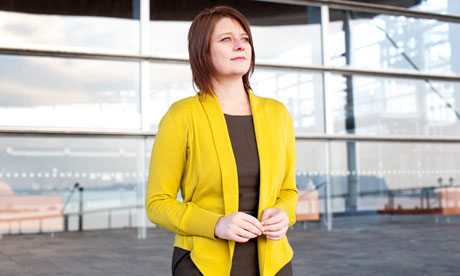
Plaid Cymru's new leader Leanne Wood
Plaid Cymru's Leanne Wood. 'In many ways she is Labour’s prodigal daughter, which is why it fears her the most.' Photograph: David Levene for the Guardian
It is perhaps a deliberate piece of symbolism that Plaid Cymru heads this weekend for its annual conference not to the northern or southern coastal strips but to Powys, the great land-bridge that connects the whole of Wales. It's certainly a metaphor for the challenge that Leanne Wood, the new leader, faces. Can Plaid become the truly national party it proclaims itself to be in a small country still bedevilled by division?
It's here in the heart of Wales that past attempts to unite behind a single flag have flourished, then foundered. Cymru Fydd, the home rule movement that Lloyd George briefly flirted with, was born just up the road. And it was in the town of Brecon where conference delegates gather that Owain Glyndwr won his last battle in the war of independence exactly 600 years ago, only to die, a broken man, somewhere in the semi-autonomous republic of Erging to the east.
After centuries of struggle and a lot of introspection, we have somehow managed to claw our way back to that same halfway house of semi-autonomous status. So where do we go from here? Answering that question, Plaid's satnav has a bright new voice. Wood is not only the first woman to lead the party, she is the first, like 80% of Welsh people, who wasn't brought up a Welsh language speaker. She's also the only working-class leader of a major party in Britain today. In many ways she is Labour's prodigal daughter, which is why it fears her the most.
With a few council byelection victories recently chalked up, Plaid's battalions gather in Brecon in buoyant mood: just try booking a hotel there this weekend within a 145-mile radius. But bringing Brecon to a standstill is not quite the same feat as doing it in Barcelona, as 1.5 million Catalans did on Tuesday. Plaid is, for the moment at least, small-nation nationalism's underachiever.
But we live in singular times. Pro-independence Québécois – almost wiped out by the NDP in last year's federal elections – were carried to victory in the province last week on a noisy wave of pan-wielding students. In Rio in 2016 Andy Murray may be vying with Chris Hoy to win the first gold medal in a Scottish vest. Carwyn Jones, the Welsh first minister, likes to joke that if England too leaves the union he will have to argue with Peter Robinson, first minister of Northern Ireland, over who gets the seat at the security council. He has already said who'll get the nukes.
It is this chronic lack of ambition, and the confidence needed as its foundation, in our country and in our ourselves, that is the essence of the Welsh predicament. Wales should be a "laboratory of innovation" for a Labour party everywhere else in opposition. But there has been a curious lack of creativity in Cardiff Bay. Last month's announcement of a new Welsh government-backed Public Policy Institute is a welcome move – but it's odd that it won't be able to commission outside research. It will be a thinktank, as one blogger put it, that cannot think.
There are some at least prepared to flex their devolutionary muscles, as Leighton Andrews, the Welsh education minister, did this week over the English GCSE debacle. But the cruel fact is that while we may be able to upgrade those pupils' exam results, not enough is being done to upgrade their long-term prospects. Welsh youth unemployment has increased almost fourfold in a year, and the Welsh wealth gap with the rest of Britain is wider now than at any time in our history.
It is too easy to blame the Tories or England for our problems. All of us in Wales have to take our share of responsibility. Welsh nationalism's fault has been its failure to communicate directly with people in all parts of Wales. A party that wanted to conserve (language and culture) and modernise (economy and institutions) at the same time was always going to run the risk of sending mixed messages. Seen through a largely external media's lens, Plaid, with its monolingual moniker, was branded a Welsh language party in the mental maps of the English-speaking majority.
This conference is a chance to recalibrate Welsh nationalism's priorities, and train its sights squarely on the squandered potential that is today's Welsh economy. The party needs to make a wager with the Welsh people – too poor for independence now, elect us so we can ensure it's a realistic choice in the future. It needs to ditch its pressure group mentality and present itself as a political party with a programme for government. And to do that it must reach out in new ways to every person in Wales. It's a perestroika moment for a country crying out not just for new ideas and new hope but also, perhaps, a new party of Wales.

Tuesday, 4 September 2012

Hot on the Heels of Scotland

With Alex Salmond's pronouncement on the programme for Independence which will occupy parliamentary procedure for the next year, as well as the appointment of David Jones, an arch-unionist and anti-devolutionary, as Secretary of State for Wales, it behoves all Welsh nationalists of whatever shade of political opinion to strive even harder and push for Welsh Independence hot on the heels of Scotland. The next two years will be critical in the long struggle towards independence by the two Celtic nations. The retreat of the Britons in AD 600 following the Battle of Chester brought about the separation of the North Britons of Cumbria and Strathclyde and the West Britons of Wales and Cornwall. The two countries are linked by custom, culture, ethnicity and tradition. Yet in these modern times I suggest that nationality should be determined by allegiance alone and not by ethical considerations. One of the SNP's most vocal and effective patriots is of Asian parentage.

The vision of Cymru Fydd is undimmed. Despite those unionists who have been promoted into high positions in the British heirarchy by a Conservative-led government in Westminster and the determination of that government to maintain the status quo, the choice is open for the peoples of Wales and Scotland, an opportunity which will not be available beyond 2014, to embrace their destiny and assert their independence and thus create free and sovereign self-governing nations. 

Cymru - hot on the heels of Alban; Kernow - hot on the heels of Cymru; Breizh (Brittany) - hot on the heels of Kernow - free from domination and proud of their inheritance.

Alanindyfed 

Monday, 27 August 2012

An Open Plea to the First Minister

Mr Salmond,

Would it be appropriate for me to request my booking for Scottish citizenship now, assuming it would be granted, or should I await the successful outcome of the referendum on Scottish Independence in the autumn of 2014?
I would hope that my services to independence on this blog be recognised in this way....

In anticipation,
Yours truly,
Alanindyfed

Tuesday, 7 August 2012

All Quiet on the Western Front

Readers and followers of this blog may have been wondering why alanindyfed has allowed the blog to remain in abeyance over several months. The reason is simple. We are awaiting the outcome of the referendum on Scottish Independence. As you may recall, we stated that Welsh Independence is dependent on the result of the Scottish referendum, so all eyes should be on Scotland. When Scottish Independence becomes a reality, as all indications show will be the case, then the blog will return in earnest to enthuse the Welsh public to demand a Welsh referendum to determine the future of the nation of Cymru.
Note that Welsh electors will be voting to establish the independent nation of Cymru within the European community.

The Scottish government is on a roll, with Alex Salmond as its dynamic and charismatic First Minister. Watch the proceedings of the Scottish parliament on the Parliament Channel and in particular, First Minister's Questions. It will be clear that the SNP is determined to succeed in its task of disestablishing itself from the United Kingdom for the benefit and the prosperity of the Scottish people.


Scottish independence: MPs call for referendum power transfer

A committee of MPs has called on the UK government to hand the Scottish Parliament new legal powers to hold a referendum.
The Scottish Affairs Committee said a section 30 order (S30) should be used to ensure the referendum is "legally and morally watertight".
It claimed "overwhelming evidence" showed Holyrood did not have the power to hold a legally binding referendum.
The Scottish government said it had "no objection" to an S30 being used.
But it said it would only be acceptable if there were "no Westminster strings attached".
The Scottish Affairs Committee is currently comprised entirely of MPs from the three major pro-union parties - the Conservatives, Labour and Liberal Democrats.
The committee has been taking evidence for its Inquiry into the Referendum on Separation for Scotland.
Its report warned Scotland risked "indefinite legal and political wrangling and future uncertainty" if it was conducted on a "dubious legal basis" which was challenged in the courts.

“Start Quote

We have always said that we have absolutely no objection to an S30 Order in regard to the referendum, so long as no Westminster strings are attached”
Spokesman for Bruce Crawford
Committee chairman Ian Davidson MP said: "It is clear from our evidence that the Scottish Parliament has no powers to hold either a binding or an advisory referendum on constitutional change.
"We believe the best way to proceed is for the government to propose a detailed and specific Section 30 (S30) notice, giving the Scottish Parliament powers to conduct a referendum on separation.
"This S30 notice should be subject to a scrutiny process by the Scottish Affairs Committee and approval by Scotland's MPs."
The SNP government at Holyrood wants to hold a referendum on Scottish independence in the autumn of 2014.
A spokesman for Bruce Crawford, the Cabinet Secretary for Parliamentary Business, said: "We have always said that we have absolutely no objection to an S30 order in regard to the referendum, so long as no Westminster strings are attached - and an order on that basis could be agreed very shortly.
"The real issue is that the terms and timing of the referendum must be decided in Scotland, by the Scottish Parliament - not dictated by Westminster - and that includes a possible 'more powers' option.
"It is only right that these matters are carefully and properly considered, which is exactly what the Scottish government is doing."
A Scotland Office spokesman said: "This report supports the position that we need a legal, fair and decisive referendum for the people of Scotland.
"We have an open offer to the Scottish government to engage with us on securing an S30 order."

Tuesday, 13 March 2012

Small Country - Big Heart

St. Patrick and the First St. Patrick's Day Parade


Saint Patrick, who lived during the fifth century, is the patron saint and national apostle of Ireland. Born in Roman Britain, he was kidnapped and brought to Ireland as a slave at the age of 16. He later escaped, but returned to Ireland and was credited with bringing Christianity to its people. In the centuries following Patrick's death (believed to have been on March 17, 461), the mythology surrounding his life became ever more ingrained in the Irish culture: Perhaps the most well known legend is that he explained the Holy Trinity (Father, Son and Holy Spirit) using the three leaves of a native Irish clover, the shamrock.


Since around the ninth or 10th century, people in Ireland have been observing the Roman Catholic feast day of St. Patrick on March 17. Interestingly, however, the first parade held to honor St. Patrick's Day took place not in Ireland but in the United States. On March 17, 1762, Irish soldiers serving in the English military marched through New York City. Along with their music, the parade helped the soldiers reconnect with their Irish roots, as well as with fellow Irishmen serving in the English army.


Growth of St. Patrick's Day Celebrations

Over the next 35 years, Irish patriotism among American immigrants flourished, prompting the rise of so-called "Irish Aid" societies like the Friendly Sons of Saint Patrick and the Hibernian Society. Each group would hold annual parades featuring bagpipes (which actually first became popular in the Scottish and British armies) and drums.


In 1848, several New York Irish Aid societies decided to unite their parades to form one official New York City St. Patrick's Day Parade. Today, that parade is the world 's oldest civilian parade and the largest in the United States, with over 150,000 participants. Each year, nearly 3 million people line the 1.5-mile parade route to watch the procession, which takes more than five hours. Boston, Chicago, Philadelphia and Savannah also celebrate the day with parades involving between 10,000 and 20,000 participants each.


St. Patrick's Day, No Irish Need Apply and the "Green Machine"

Up until the mid-19th century, most Irish immigrants in America were members of the Protestant middle class. When the Great Potato Famine hit Ireland in 1845, close to 1 million poor and uneducated Irish Catholics began pouring into America to escape starvation. Despised for their alien religious beliefs and unfamiliar accents by the American Protestant majority, the immigrants had trouble finding even menial jobs. When Irish Americans in the country's cities took to the streets on St. Patrick's Day to celebrate their heritage, newspapers portrayed them in cartoons as drunk, violent monkeys.


The American Irish soon began to realize, however, that their large and growing numbers endowed them with a political power that had yet to be exploited. They started to organize, and their voting block, known as the "green machine," became an important swing vote for political hopefuls. Suddenly, annual St. Patrick's Day parades became a show of strength for Irish Americans, as well as a must-attend event for a slew of political candidates. In 1948, President Harry S. Truman attended New York City 's St. Patrick's Day parade, a proud moment for the many Irish Americans whose ancestors had to fight stereotypes and racial prejudice to find acceptance in the New World.


The Chicago River on St. Patrick's Day

As Irish immigrants spread out over the United States, other cities developed their own traditions. One of these is Chicago’s annual dyeing of the Chicago River green. The practice started in 1962, when city pollution-control workers used dyes to trace illegal sewage discharges and realized that the green dye might provide a unique way to celebrate the holiday. That year, they released 100 pounds of green vegetable dye into the river--enough to keep it green for a week! Today, in order to minimize environmental damage, only 40 pounds of dye are used, and the river turns green for only several hours.


Although Chicago historians claim their city's idea for a river of green was original, some natives of Savannah, Georgia (whose St. Patrick's Day parade, the oldest in the nation, dates back to 1813) believe the idea originated in their town. They point out that, in 1961, a hotel restaurant manager named Tom Woolley convinced city officials to dye Savannah's river green. The experiment didn't exactly work as planned, and the water only took on a slight greenish hue. Savannah never attempted to dye its river again, but Woolley maintains (though others refute the claim) that he personally suggested the idea to Chicago's Mayor Richard J. Daley.


St. Patrick's Day Around the World

Today, people of all backgrounds celebrate St. Patrick's Day, especially throughout the United States, Canada and Australia. Although North America is home to the largest productions, St. Patrick's Day is celebrated in many other locations far from Ireland, including Japan, Singapore and Russia.


In modern-day Ireland, St. Patrick's Day was traditionally been a religious occasion. In fact, up until the 1970s, Irish laws mandated that pubs be closed on March 17. Beginning in 1995, however, the Irish government began a national campaign to use interest in St. Patrick's Day to drive tourism and showcase Ireland and Irish culture to the rest of the world. Today, approximately 1 million people annually take part in Ireland 's St. Patrick's Festival in Dublin, a multi-day celebration featuring parades, concerts, outdoor theater productions and fireworks shows.

Monday, 5 March 2012

A Further Stain on Hain

Hain’s Raw Memoir

by Guido Fawkes
Guido hasn't read Hain's "Outside In" memoir yet, though his interview in the Observer suggests that it should, to a extent generous even by the standards of political memoirs, be filed under fiction. On being exposed for over-spending an undeclared £100,000 under-the-counter on his Labour Party deputy leadership campaign he pleads
"It was about an honest mistake and a disorganised end to the campaign and when I found out about it I told everyone. It's quite possible that nobody would ever have found out if I hadn't done that. And a lot of thanks I got for it."
Not true, Hain only went to the police about it after details were published on this blog and on the front page of the Guardian. Decca Aitkenhead says in the interview that for Hain "the subject is still terribly raw". No doubt it is, that is still no excuse for falsifying the facts.
Guido Fawkes | March 4, 2012 at 9:50 pm | Tags: Peter Hain | Categories: default | URL: http://wp.me/pvx79-mag
 Yet another stain on the character of Mr Hain