"The Nineteenth century saw a great Springtime of Nations as the revolutions of 1848 saw new countries created the length and breadth of Europe. In our world today we are now seeing our own Spring Awakening with people and cultures that have long been dormant and subdued asserting their right to exist, their right to dream." Adam Price MP
Last night I had the strangest dream
I never dreamed before
I dreamed the world had all agreed
To put an end to war
I dreamed I saw a mighty room
Filled with women and men
And the paper they were signing said
They'd never fight again
And when the papers were all signed
And a million copies made
They all joined hands and bowed their heads
And grateful prayers were prayed
And the people in the streets below
Were dancing round and round
And swords and guns and uniforms
Were scattered on the ground
Last night I had the strangest dream
I never dreamed before
I dreamed the world had all agreed
To put an end to war
A
very annoyed looking Alex Salmond was on BBC news this morning
disgusted by the rhetoric that David Cameron used yesterday calling
anyone who opposes the War..
TERRORIST SYMPATHISERS
We
share Alex Salmond’s disgust, the tone of hatred being spouted by the
UK establishment, the media and some of the general public is beyond
shameful. Between describing refugees as cockroaches and rats and just
the all round tarring of Muslims being Terrorists. It really does show
you the dire straights the UK is in.
So
unless Labour do the unthinkable and finds a shred of humanity within
them or they suddenly remember what opposition parties are meant to do,
then I am afraid Scotland YET AGAIN gets dragged into a conflict it
wants nothing to do with.
During the debate to support David
Cameron’s motion to launch airstrikes in Syria, the SNP’s Angus
Robertson MP asked a vital question which the Tory party and it’s leader
could not answer.
Robertson called on first the Prime Minister, then the Foreign
Secretary, and then the entire Conservative Party to tell him how many
of the 70,000 Syrian fighters the government are expecting to act as our
‘boots on the ground’ are moderates or fundamentalists.
Robertson isn’t alone in pointing out the flaw in Cameron’s plans. The powerful Foreign Affairs Select Committee has voted against the proposed airstrikes.
The Foreign Affairs Select Committee is chaired by Conservative MP Crispin Blunt,
and has a majority of Conservative members – yet this evening, the
powerful committee has defied the government and expressed their
opposition to the planned strikes. A Conservative member of the
committee, John Baron MP, has written a piece for The Guardian outlining
the reasons for the no vote.
The piece, entitled ‘I’ll defy my party leader, and vote against Syria airstrikes’
argues Mr Cameron has failed to learn the lessons of previously failed
interventions in the Middle East, and is doomed to repeat them if he
proceeds with the airstrikes. The MP writes:
“Though
the government has precipitated another rush into military action, it
has not yet constructed a realistic long-term strategy to destroy
Daesh/Isis. On a recent visit to Middle Eastern capitals with the
foreign affairs select committee, the officials we met were concerned we
risk making the same mistakes as we made in our previous military
interventions in Iraq, Afghanistan (post-2006) and Libya.”
And as for Cameron’s claim that 70,000 moderate Syrian ground troops
are ready to take care of the ‘boots on the ground’ element of the war?
John Baron MP confirms that on recent visits, his committee were
informed there were precious few ‘moderates’ in Syria, and even the most
moderate groups are unaligned and often fighting each other too. The
result of placing our hopes on this fractured and incoherent opposition
would, argues Baron, be to repeat the mistakes of the past:
“The government has forgotten the lessons of Libya, where
the anti-Gaddafi forces splintered into a thousand militias the moment
the common enemy was defeated. A fresh civil war has been a result.
Syria would be similar, but on a grand scale.”
The coalition were unable to hold Iraq together with hundreds of
thousands of their own troops – yet today, the plan in Syria is that
mere tens of thousands of infighting militia men will topple Daesh,
Assad, and establish a democracy. This is lunacy.
In short, the sum total of Britain’s planned intervention in Syria,
would be to kick start yet another phase of civil war. This would just
as likely strengthen ISIS/Daesh, as weaken them – killing yet more
civilians in the process.
This last minute call to common sense by the Conservative-led
committee has seemingly fallen on deaf ears. The reckless meddling of
the Bush/Blair coalition started a fire in Iraq, Afghanistan, Libya and
Syria. Now Cameron stands poised with a petrol can, ready to pour. Featured Image via YouTube Screengrab
110 MP signatories from 6 parties back amendment against Syria vote
For immediate release: Tuesday 1st December 2015
Attn: NEWS DESKS / POLITICAL CORRESPONDENTS
ALEX SALMOND: UK GOVERNMENT RUNNING FROM SCRUTINY ON SYRIA
110 MP SIGNATORIES FROM 6 PARTIES BACK AMENDMENT AGAINST SYRIA VOTE
Over
one hundred MPs have signed a cross-party amendment against tomorrow’s
vote on air strikes in Syria, with key signatories including SNP
Westminster Leader Angus Robertson MP, Green MP Caroline Lucas, Hywel
Williams of Plaid Cymru, SDLP MP Alasdair McDonnell and Labour MP Graham
Allen as well as Conservative John Baron MP. Commenting, Alex Salmond MP said:
“We
are seeing an arrogance from David Cameron who believes his
ill-conceived plans to add more planes to the 10 countries already
bombing Syria will make a difference.
“Support
for this amendment against Syria air strikes is cross-party, and so far
has 110 signatories. Of course everyone wants to see the end to Daesh,
but the UK government has been running scared from scrutiny on their
plans which don’t stack up.
“We don’t know how
the UK government plans to secure peace in Syria and what ground forces
there will be. We know the UK previously spent 13 times more bombing
Libya than on its post conflict stability and reconstruction.
“And
just two years ago the Prime Minister urged us to bomb the opponents of
Daesh that would have likely strengthened this terrorist organisation.
“The
influential Foreign Affairs Committee took a wide range of evidence
from military experts, academics, lawyers, the Foreign Secretary and
Syrian groups. As a result a number of questions were presented to the
Prime Minister and today a majority of committee members agreed that
these questions had not been answered.”
ENDS
SNP MEDIA 0207 219 1602
Note to Editor:
The cross-party amendment:
Delete after ‘House’ and insert, ‘while
welcoming the renewed impetus towards peace and reconstruction in
Syria, and the Government’s recognition that a comprehensive strategy
against Daesh is required, does not believe that the case for the UK’s
participation in the ongoing air campaign in Syria by 10 countries has
been made under current circumstances, and consequently declines to
authorise military action in Syria.’
Angus Robertson knows how to do things
He wanted to know if the PM would seek a UN resolution should he decide to bomb the bejesus out of Syria.
This was a straight question to which only a straight answer would do. So Mr Cameron said no because the Russians would only veto it.
Mr Robertson pointed to a new poll out today showing only 15% of Brits in favour of blitzing Syria.
Mr
Cameron said: “My job, frankly, as Prime Minister, is not to read an
opinion poll, it’s to do the right thing to keep this country safe.”
Having
dismissed the views of the nation Mr Cameron trotted off to do some
more prime ministering unencumbered by public opinion.
But he would do well to remember the public’s current opinion of Tony Blair.
He might not then be quite so keen to ignore it.
Supporters of a Yes vote in the Scottish independence referendum in Edinburgh in September 2013. Andy Buchanan/AFP/Getty Images
Scotland would vote for independence if a second referendum on leaving the UK was held tomorrow, according to a new poll.
The Ipsos MORI poll for the STV channel found that a would-be ‘Yes’ campaign would have a nine-point lead over the ‘No’ camp.
53
per cent of Scottish voters would vote ‘Yes’ while 44 per cent would
vote ‘No’, with three per cent undecided which way they would vote, the
survey suggests.
This poll marks the first lead for leading the UK since the last referendum.
Half
of those surveyed said they would like to see another referendum in the
next five years, while 58 per cent said they would be in favour of
another vote being held within ten years.
The poll is thought to
be the first to show a majority for independence among all those
questioned. It was described as “pretty all-round sensational” by SNP
leader Nicola Sturgeon.
The results of the survey may increase the
pressure on Ms Sturgeon to include the promise of a second referendum
in the SNP’s manifesto for next year’s elections. She has previously
said that another vote would only be held if there was a “material
change” in the country’s circumstances.
Derek Mackay, the party’s
Business Convener, said: “We warned the Tories that support for
independence would only grow if they continued to ignore Scotland’s
voice – and this poll proves that, as people question Westminster’s
ability to represent Scotland’s interests at all.”
The findings come the day after the Scottish Government announced its programme for the final year of parliamentary time before the 2016 Scottish Parliament elections.
Ms Sturgeon announced a number of new policies including new rent controls for areas where housing costs are rising fast.
Some
polls during the Scottish Independence referendum campaign suggested
that the ‘Yes’ side might triumph, though it ultimately lost by 45 per
cent to 55 per cent in favour of staying in the UK.
Who is responsible for the wars in the Middle East, and who created the refugee problem? Who is casting Russian President Putin as the bogey man? Who is using the media and the politicians to spread disinformation?
NICOLA Sturgeon has promised to introduce a
“credible, deliverable and affordable” plan to mitigate any cuts to tax
credits made by the UK Government.
The SNP leader made the
commitment during First Minister’s Questions yesterday lunchtime in a
fractious exchange with Labour leader Kezia Dugdale.
Sturgeon said
the Scottish Government would keep up the pressure on George Osborne to
“drop his plans for tax credit cuts”. She also accused Labour of
missing the point.
“It is all too typical of Scottish Labour that,
just when the pressure on George Osborne is building across the UK, the
party eases up on the Tories and attacks the SNP instead. It seems that
old habits and old friendships die hard,” the First Minister said.
“We
will keep up the pressure on the Tories to drop the cuts altogether
and, if they do not completely reverse them, we, as a responsible
Government, will introduce credible, deliverable and affordable plans to
protect low-income households, just as we did on the bedroom tax.”
During
her speech at Scottish Labour’s conference last week Dugdale made a
commitment to restoring any money lost by families affected by George
Osborne’s plan to cut the UK’s tax credit bill by £4.4 billion. This
would be funded, the Scottish Labour leader, said through higher tax and
by refusing to abolish air passenger duty (APD).
In a debate in
the parliament on Wednesday, Social Justice Minister Alex Neil said that
the Scottish Government would be able to use new tax and welfare powers
coming to Holyrood to top up lost tax credits.
Dugdale said the
First Minister’s plan was a “vague assurance” and asked her to guarantee
that “every family will receive the same entitlement from the
Government as they do now”.
The First Minister did not make that
guarantee but repeated her earlier answer that any solution brought by
the government would be credible and affordable.
“I say to Kezia
Dugdale that the detail of this matters to the families out there who
are affected. One of the details that matter most is how the tax credits
policy would be paid for.“
APD, Sturgeon said, “would not be
available when Kezia Dugdale was required to pay for the tax credits
policy.” The First Minister then said Dugdale had already promised to
spend “that money on education. So in the space of 24 hours Labour
managed to spend the same sum of money twice over. I say in all
seriousness to Kezia Dugdale that that is basic incompetence and,
frankly, the people of Scotland deserve better.”
Dugdale said:
“Yesterday in the House of Commons the Prime Minister told working
families they would just have to wait and see what happened next. Today
in this chamber, the First Minister is saying exactly the same thing. I
have listened to Nicola Sturgeon very carefully, I have listened to Alex
Neil very carefully on the TV last night.
“Both have said that
they will ensure that the income of those in receipt of tax credits
won’t fall. But that sounds a little like the Tory argument that higher
wages will automatically make up the difference.
“So can I ask the
First Minister again – under the Scottish Government’s proposal, will
every single family receive the same entitlement from the Government as
they do now?”
Sturgeon responded: “I am not quite sure what it is
that is difficult to understand. I don’t yet accept that these cuts will
take place because there is pressure building on George Osborne to
reverse them.
“So I think right now that is where we should be, united, in making sure the pressure stays on the Tories.”
The National View: FM’s commitment to mitigating effect of Tory cuts is welcomed
Long before the spectre of Catalan independence began to dominate
Spain’s political discourse, the small hamlet of Gallifa, population
215, had already broken away from the motherland.
“We proclaimed ourselves to be a free and sovereign territory of Catalonia,”
said Jordi Fornas, who was then mayor of Gallifa, a village tucked into
the hills about 30 miles north of Barcelona. “We tried to find our way
in the Spanish state, but it proved to be impossible.”
Gallifa then went one step further, becoming the first municipality
in the region to practise what Fornas called “fiscal sovereignty”, a
purely symbolic gesture of handing over its taxes to Catalonia rather
than Madrid.
As Catalan authorities rerouted the revenue – amounting to about
€1,600 in 2012 – to Madrid, Gallifa caught the attention of Spanish
media, which christened its cluster of ochre brick houses the “crib of
Catalan independence”.
On Sunday, Spain
will get a glimpse of how far the movement that first took root in
small villages such as Gallifa has spread, as Catalans cast their votes
in a regional election billed as a quasi-referendum on independence.
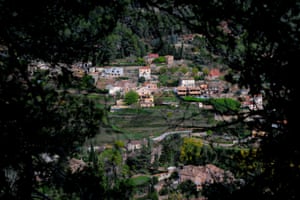
The village of Gallifa, near Barcelona. Photograph: Josep Lago/AFP/Getty Images
The results could launch Spain into uncharted territoryand plunge the
country into one of its deepest political crises of recent years, as
Madrid squares off against an openly secessionist government of a region
that accounts for 16% of Spain’s population and a fifth of its economic
output.
With polls suggesting pro-independence parties could gain a slim
majority on Sunday, a barrage of warnings was unleashed this week by
those opposed to independence.
Spain’s central bank said secession would risk exclusion from the
eurozone, while the country’s main banks – including two based in the
region – cautioned that independence could undermine financial stability
just as the country was beginning to shake off the lingering effects of
the economic crisis.
The Spanish government argued that if Catalans broke off from Spain
it would cost them their Spanish nationality, while the president of the
Spanish professional football league said Barcelona would be left out
of La Liga.
“Catalans aren’t being told the real consequences of independence,”
the Spanish prime minister, Mariano Rajoy, told Onda Cero radio station
on Tuesday. “It would leave the EU. What would happen with pensions?
There are many more pensioners than contributors. What would happen with
financial institutions, with bank deposits, to the currency?”
In recent years, his conservative People’s party (PP) has repeatedly blocked demands by Catalonia
to hold a referendum on independence, insisting that Spain’s
constitution precludes regions from unilaterally making decisions on
sovereignty.
Rajoy’s hardline stance has been backed by leaders across Europe,
many of them aware that any gains made in Catalonia could spark hope
among the other secessionist movements that dot Europe.
The British prime minister, David Cameron, said Catalonia would be
left out of the EU if it broke off from Spain, while Germany’s
chancellor, Angela Merkel, voiced her support for the “integrity of
Spain”. The PP said Nicolas Sarkozy, France’s former president, was
scheduled to join Rajoy in Catalonia on Friday in a rally against
independence.
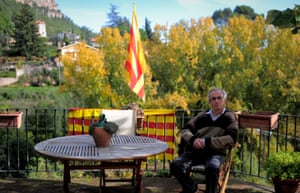
Jordi Fornas, a former mayor of Gallifa. Photograph: Josep Lago/AFP/Getty Images
The Catalan leader Artur Mas,
who has vowed to begin the process of breaking off from Spain if his
Junts pel Sí (Together for Yes) party wins a majority of seats on
Sunday, lashed out at the “strategy of fear” being used to counter the
push for independence. “It is irresponsible and indecent to issue
threats that nobody in a democratic country would dare voice,” he said.
“They do it because they have no other arguments.”
Advertisement
As
Gallifa gained a reputation across Spain for its stance on sovereignty,
its leaders also found themselves on the receiving end of Madrid’s
wrath. Citing a three-decades-old law, the central government demanded
the town fly the flag of Spain. Fornas responded by affixing a tiny Spanish flag, no bigger than the palm of a hand, to the facade of the town hall.
“The law didn’t specify what size the flag needed to be,” said Fornas, who also raised a full-sized estelada,
the flag of Catalan independence, nearby. The central government struck
back, taking legal action against the village to have the mini Spanish
flag replaced with a full-size flag. Today no flags – pint-sized or estelada – fly in Gallifa.
In many ways, Gallifa’s row with Madrid epitomises how the push for
independence has played out across Catalonia, with the central
government looking to the courts to shut down dissent
rather than seeking to address the underlying grievances over
Catalonia’s language and identity, as well as concerns that the region
pays more in taxes than it receives in investments and transfers from
Madrid.
Support for Catalan independence began growing in 2010, after Spain’s
constitutional court ruled that Catalonia’s status and powers could not
be considered tantamount to those of a nation. According to the
region’s Centre for Opinion Studies, in 2010 just under 20% of Catalans
supported outright independence. By June 2015 this proportion had almost
doubled to 38%, down from a high of 48.5% in November 2013.
Celebrations on Diada, Catalonia’s national day. Photograph: Jorge Guerrero/AFP/Getty Images
Some, such as Catalan film-maker Joan Planas, bucked the trend. The
former ardent separatist from the small town of Sant Fruitós de Bages,
near Barcelona, changed his perspective on independence after travelling
through Spain, filming his conversations in bars across the country as
part of a documentary exploring the challenges facing modern-day Spain.
Advertisement
“I
realised that many of the things that I thought about the rest of Spain
weren’t quite true,” said the 33-year-old. “I thought that the rest of
Spain rejected all that was Catalan – but I realised that it wasn’t that
way.” The realisation prompted him to vote to stay with Spain in
Catalonia’s symbolic referendum on independence last year.
With just days left until an election that has divided Catalans,
nobody knows quite which camp to put him in, he said. “I have a
brother-in-law who told me that after a few days with him, I’ll change
my mind again,” laughed Planas.
But most in Spain have taken a firm stance on the issue. This week
the Catholic church waded into the debate, saying there was no moral
justification for independence and urging Spaniards to pray for the
unity of Spain. The intervention stoked grievances, as the church had
backed General Franco, who sought to suppress Catalonia’s language and identity during Spain’s nearly four decades of dictatorship.
On the other side of the divide were 13 world-renowned Catalan
scientists and researchers who penned a letter this week promoting
independence, saying it was the best option to guarantee funding for
research in the region.
In July, Bayern Munich coach and Catalan native Pep Guardiola announced he was joining Junts pel Sí as a symbolic candidate,
backing the party in its quest to break away from Spain. “This is an
opportunity we have to build a new and more just country, starting from
scratch,” Guardiola said in a campaign video. “Nobody can stop the will
of the people.”
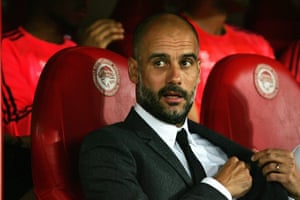
Bayern Munich’s coach, Pep Guardiola, has joined Junts pel Sí,
supporting Catalan independence. Photograph: Spyros Chorchoubas/EPA
Regardless of the outcome, the elections will mark a defining moment
for the region, said Jordi Sànchez, president of the Catalan National
Assembly, a grassroots pro-independence group that is part of Junts pel
Sí. “Nobody doubts – not in Catalonia or in Spain – that these elections
are the most important ever in Catalonia,” said the 50-year-old. “This
is an opportunity to create a better society, with the economic and
legislative resources that we don’t have right now.”
His group lobbied hard for Junts pel Sí to promise to launch the
independence process if separatists earn a majority of seats on Sunday,
even if they are denied a majority of the vote. Critics on both sides of
the issue have argued that the focus on seats, rather than votes, could
hamper the movement’s ability to gain legitimacy internationally. “We
know that elections aren’t the best instrument – it’s not what we would
have wanted, but it was the only tool we had at our disposition,” said
Sànchez.
The use of elections to address the issue has also put politicians
such as Mas on the frontlines of the movement, rather than the hundreds of thousands of Catalans who
have filled the streets on Barcelona for four successive years to
demand a say on Catalan independence, said Sànchez. “In a few years, in
some universities, they’re going to study the political process playing
out in Catalonia right now,” he said. “Citizen mobilisation managed to
convince political parties to change their political agenda. This is an
incredible moment for democracy – one of the most important for Europe.”
In 2010 just under 20% of Catalans supported outright independence. By
June 2015 this proportion had risen to 38%, down from a high of 48.5% in
November 2013. Photograph: Gerard Julien/AFP/Getty Images
The process of democratic regeneration is not just limited to
Catalonia, said Carlos Rivadulla of Empresaris de Catalunya, an
association of entrepreneurs in the region who oppose independence. As
Spain emerges from the economic crisis, citizens across the country have
taken aim at the institutions and politicians who brought the country
to the brink of ruin, leading to a widespread demand for democratic
regeneration, “All over Spain, we want a new deal, whether it’s a new
constitution or reform,” said Rivadulla, pointing to the rise of
political parties such as Podemos and Ciudadanos. “We could call it the Spanish spring.”
This demand for change could help parties such as Podemos, which
supports a referendum on Catalan independence, or the Socialists, who
propose making Spain a federal country, make gains in the country’s
general elections, due by the end of the year. If so, Spain could usher
in a government more open to addressing Catalan grievances.
If Catalan separatists win power on Sunday, Rivadulla believes they
will take incremental steps towards independence, biding their time
until a new central government take power. Polls suggest no party will
earn an absolute majority in the general elections, meaning Catalan
leaders could have a better chance of negotiating greater
self-governance for Catalonia or a binding referendum by the end of the
year.
Others echoed his analysis. In Gallifa, Fornas doubted Sunday’s
election would bring about the independent Catalonia he had waited his
whole life for, even if Junts pel Sí won a strong mandate.
Fornas pointed to the 18-month timeline for the transitional
government, arguing it was a drawn-out schedule for a task that his
hamlet had managed to accomplish in just one day. “It doesn’t take 18
months to become independent,” he said. “In the US, they celebrate
independence day, not independence months.”